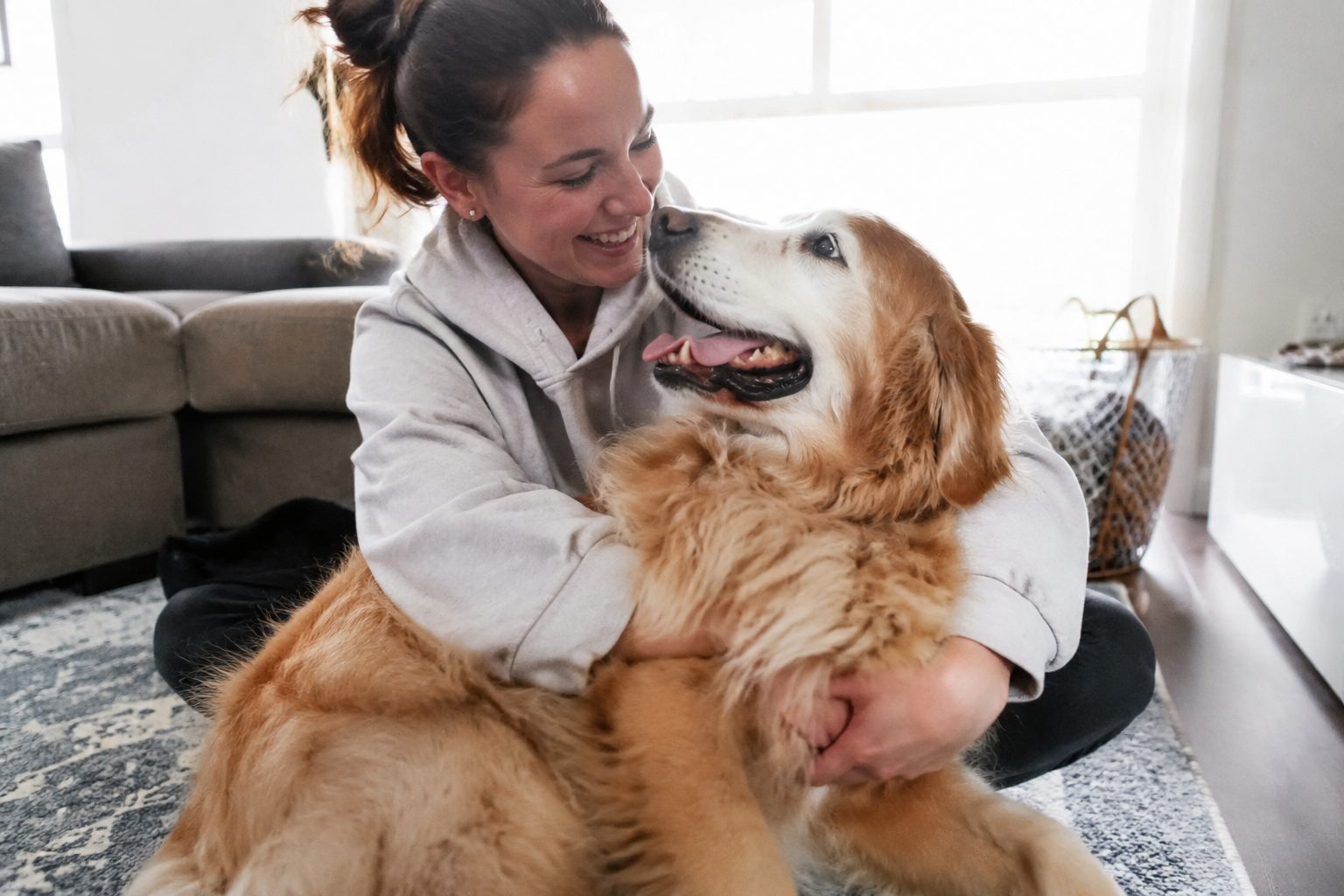
Dog crusty eyes are usually harmless when it is a small, dry, light-brown or gray crust in the inner corner after sleep, the same on both sides, in a dog who is bright and keeping both eyes wide open. A damp cotton pad handles that. Squinting, a red eye, a cloudy surface, thick yellow-green discharge, or one eye that keeps crusting for days is different, and it is one of the signs a dog's eye infection needs a vet.
If your dog's eye is held shut, looks blue-white or cloudy, or seems to hurt, skip the reading and call a vet today. A scratched cornea hurts, and eyes are not worth waiting on.
Why Do Dogs Get Crusty Eyes?
Tears are a mix of watery fluid, oil and mucus, and the eye is always shedding a little of that along with dust and loose cells. Some of it drifts to the inner corner and dries. That is what most owners call eye crusties or eye boogers, and a small amount is a common sight after a nap. No study I found sets a "normal" amount.
Crust is a symptom, not a diagnosis. A vet's guide to excess tearing describes it the same way: a sign of overflow or poor drainage, not a disease in itself. Eye discharge in dogs has many sources. Allergies, irritants like smoke or dust, a lash rubbing the eye, a blocked drainage duct and true infections can all leave dried discharge behind, so the crust alone tells you very little. What matters is its color, how fast it returns, which eye it is in, and how your dog acts.
The Dog Crusty Eyes Test: Morning Versus All Day
Here is the check I would run before anything else. Clean both eyes at bedtime. In the morning, note how much crust has built up. Then look again around midday and mid-afternoon, once your dog has been awake and blinking for hours.
Crust that appears only after sleep, stays small and matches on both sides is the most reassuring pattern. Crust that re-forms within a few hours of daytime wear, grows from day to day, or shows up on one side only deserves an exam. This is my rule of thumb for sorting cases, not a diagnostic test, and no study I found sets an exact cutoff.
Color, Sides and Behavior: What to Do
Color alone cannot diagnose an eye, so read each row together with how your dog is acting.
| What you see | One eye or both | Behavior | What I would do |
|---|---|---|---|
| Small, dry, light-brown or gray crust at waking | Both | Bright, eyes open, whites clear | Wipe with a damp pad and keep a log. |
| Clear, watery, more than usual | Both | Normal | Check for hair, pollen and wind. See our guide to watery eyes. |
| Reddish-brown staining below the eye | Both | Comfortable | Mostly cosmetic. Keep the area clean and dry and trim the hair. |
| Sticky white-gray mucus, hard to wipe away | One or both | Any redness or squinting | See a vet, especially in a middle-aged or older dog, since dry eye in dogs can look like this. |
| Thick yellow or green | Either | Any | Vet within the day. More on green or yellow eye discharge. |
| Any color | One eye only, for days | Pawing, blinking | Vet visit. A one-sided purulent discharge that will not clear can come from a foreign body such as a plant seed lodged in the tear duct. |
| Any color | Either | Squinting, closed eye, cloudy or blue-white surface, bulging, recent injury | Same-day vet or emergency clinic. |
Seven-Day Photo Log
If the crust is not clearly normal, a week of notes gives your vet far more than "it's been a while." Photograph the inner corner before you clean, in the same light and from the same angle. Each day, write down seven things:
- Date and time of day, morning and afternoon.
- Left eye or right eye, recorded separately.
- Color: clear, gray, brown, yellow or green.
- Amount on a 0 to 3 scale, from none to heavy.
- Squinting, blinking or pawing at the face: yes or no.
- Anything new: bedding, shampoo, a different walk, wind in the car.
- A close-up photo, taken before you clean.
The 0 to 3 scale is just our own shorthand, not a clinical score. Bring the photos and note when it started.
How to Clean Crusty Dog Eyes
- Wash your hands and use a clean cotton pad or soft gauze. Avoid cotton swabs and anything that sheds fibers.
- Use a fresh pad for each eye so you never carry anything from one side to the other.
- Rest a warm, damp pad on the crust for 30 to 60 seconds without rubbing. That timing is my own habit, not a published standard. For stubborn crust, a gentle cleaning solution such as dog eye drops for tear stains and debris can go on the pad, never straight into the eye.
- Wipe from the inner corner outward, using a clean face of the pad each pass.
- Dry the skin and move the hair away from the eye. A vet guide to tearing lists a clean, dry area and trimmed hair as the baseline.
- Once a day is a sensible default, not a published rule. If you think it needs more, ask your vet first.
Leave out hydrogen peroxide, which veterinary sources advise against near the eyes, as well as alcohol, bleach, essential oils and tea. Ask your vet before putting any human eye drop on your dog, and never reuse leftover prescription drops from an earlier problem. If the crusting began around the time your dog started a new monthly chew, mention that to your vet as well, and our guide to side effects owners report with NexGard lists what's on the label.
Mistakes Owners Often Make
- Waiting out an eye that is squinting.
- Scouring tear stains with harsh products. Stain remedies are largely unproven, and some can do harm.
Myths and Facts
| Myth | Fact |
|---|---|
| Crust means infection. | Often it is only dried tears and mucus. Color, redness and behavior say more than crust does. |
| Tear stains mean a dirty dog. | Staining reflects tear overflow, which is a symptom with several causes. |
| A supplement or eye product will make the crust stop. | No cleaner addresses the cause. Crust that keeps returning is a reason to investigate. |
| Two crusty eyes are fine, one is nothing. | One eye that stays crusty for days merits an exam. |
Breed and Age: Who Has More Eye Trouble
The largest datasets I could verify come from UK VetCompass, which tracks dogs seen at ordinary veterinary practices in the UK. Dogs in the US are probably similar, but I cannot promise that. These numbers describe risk, not your dog's diagnosis.
| Condition | Overall rate | Higher-risk breeds |
|---|---|---|
| Dry eye (KCS) | About 4 in 1,000 dogs | Flat-faced dogs had about 3.6 times the odds. American cocker spaniels, English bulldogs, pugs and Lhasa apsos stood out. |
| Corneal ulcer | About 8 in 1,000 dogs | Pugs (5.4%), boxers (5.0%) and shih tzus (3.5%). Flat-faced dogs had about 11 times the odds. Pain was recorded in 46.2% of cases. |
| Entropion (eyelid rolling in) | About 3 in 1,000 dogs | Shar-Peis (15%) and chow chows (9%). Nearly one in five new cases had surgery. |
Age matters too. The dry eye study found it strongly associated with age, and the classic picture is a middle-aged or older dog with a red eye and thick, yellowish mucus. I could not verify puppy-specific numbers, so if a puppy's eyes crust all day, ask your vet.
Where Eye Cleaning Drops Fit
A cleaning solution is for softening and lifting dried debris from the skin and fur around the eye. It does not treat infection, dry eye or ulcers, and since stain products have not been shown to work in research, the realistic job for one is gentle cleaning rather than stain removal. Pure Majesty Pets makes its dog eye drops as a non-medicated cleaner, and the label describes it as dissolving dried eye boogers.
| Feature | What it does | What it does not do |
|---|---|---|
| Non-medicated, sterile filtered to 10 microns | Filtered for a clean fill | Treat any condition or replace a vet's care |
| pH 7.0 to 7.2 | Chosen to sit close to natural tear pH | Guarantee zero irritation on every dog |
| 0.05% sodium hyaluronate | Helps keep the pad and crust moist | Treat dry eye |
| 2% chamomile and 8% aloe | Traditional soothing ingredients for the skin | Reduce inflammation, as far as the sources I checked show |
| 0.15% sodium phytate | Included as a mineral-binding agent | Have proven stain-removing effects |
| No bleach, peroxide, alcohol or fragrance | Leaves out the irritants vets warn about | Make it safe to put in the eye |
| 120 mL, made in Canada, $32.80 | Enough for regular use on a pad | Tell you how many days a bottle lasts |
For context, I read the product pages of four dog eye products sold online in the US. One is an eye wash, so they are not identical products. The table records only what each page published, and "not stated" means I did not find it on the page I read.
| Product (page read) | Ingredients and concentrations published | pH | Sterile | Medicated or antimicrobial |
|---|---|---|---|---|
| Pure Majesty Pets dog eye drops | Hyaluronate 0.05%, chamomile 2%, aloe 8%, phytate 0.15% | 7.0 to 7.2 | Filtered to 10 microns | Non-medicated |
| Burt's Bees tear stain remover (PetSmart) | Chamomile named, no concentration. Full ingredient list not stated on the page. | "pH balanced," no number | Not stated | Not stated |
| Angels' Eyes tear stain solution (Chewy) | Listed: purified water, glycerin, decyl polyglucoside, propylene glycol, phenoxyethanol, dimethyl isosorbide, aloe vera, disodium EDTA, benzalkonium chloride, chamomile extract. No concentrations. | Not stated | Not stated | Not stated. Page says external use only. |
| Vetericyn Plus eye wash (Chewy) | Active: hypochlorous acid 0.009%. Inactive: electrolyzed water, sodium chloride, phosphates, sodium hypochlorite, no concentrations. | Not stated | Not stated | Named "antimicrobial" |
| Nutri-Vet eye rinse (Jeffers) | Boric acid, filtered water, sodium borate, sodium chloride. No concentrations. | Not stated | Not stated | Not stated. Page says it "fights eye infections." |
A few label facts from those pages. Angels' Eyes lists benzalkonium chloride and phenoxyethanol among its ingredients. Nutri-Vet's page says the rinse "fights eye infections," and Vetericyn carries "Antimicrobial" in its name. Our page claims no treatment of any kind, and says the formula has no bleach, peroxide, alcohol or fragrance. I did not compare full ingredient lists, so I am not claiming more than that.
When you read any eye-cleaner label, ask four things. Does it publish concentrations? Does it state a pH? Does it say how it was sterilized or filtered? Does it make a medical claim, and is that claim one a cleaner can support? The Pure Majesty Pets eye drops page answers yes to the first three, with 0.05% to 8% concentrations, pH 7.0 to 7.2 and 10-micron sterile filtration, and it makes no medical claim. That does not make one product work better, and the phytate line still carries no proven stain effect.
If crust is not better in a few days, book the vet rather than trying something stronger.
What to Do Tonight
For ordinary dog crusty eyes, a small crust each morning, a damp pad and a quick look at the whites are plenty. Keep a log if anything changes, and let behavior outrank appearance.
Frequently Asked Questions
Is morning crust in my dog's eyes normal?
A small, dry crust in the inner corner after sleep is common and usually harmless. Redness, squinting, thick yellow-green discharge or a cloudy eye is not.
Can I use human eye drops on my dog?
Ask your vet first, since no product should go in a dog's eye without vet advice. Never reuse old prescription drops without checking, because the cause may be different this time.
Why is only one of my dog's eyes crusty?
A hair or lash, a foreign body, an eyelid problem or a blocked duct can affect one side. If it lasts more than a few days, have it examined.
How often should I clean my dog's eyes?
Once a day is a sensible default, though that is my rule of thumb, not a published standard. Ask your vet before cleaning more often.
This article is general information and not a substitute for a veterinary exam. If your dog's eyes look painful, cloudy or very red, or the discharge changes, have a veterinarian examine your dog.
Scientific References
- O'Neill DG et al. Keratoconjunctivitis sicca in dogs under primary veterinary care in the UK: an epidemiological study. J Small Anim Pract. 2021. PubMed 34134171, DOI 10.1111/jsap.13382.
- O'Neill DG et al. Corneal ulcerative disease in dogs under primary veterinary care in England: epidemiology and clinical management. Canine Genet Epidemiol. 2017. PubMed 28630713, DOI 10.1186/s40575-017-0045-5.
- O'Neill DG et al. Conformational eyelid disorders in dogs under primary veterinary care in the UK: epidemiology and clinical management. PLoS One. 2025. PubMed 40587483, DOI 10.1371/journal.pone.0326526.
- Tear film break-up time and Schirmer tear test in normal dogs: effects of age, sex, skull type and nasolacrimal duct patency. Vet Ophthalmol. 2023. PubMed 36039507, DOI 10.1111/vop.13021.
- Shih-Tzu show alterations in ocular surface homeostasis despite adequate aqueous tear production. Acta Vet Scand. 2024. PubMed 38229091, DOI 10.1186/s13028-024-00724-2.
- Dacryocystitis in dogs caused by foreign bodies. Vet Ophthalmol. 2022. PubMed 34984785, DOI 10.1111/vop.12968.
- VCA Animal Hospitals. Eye Discharge (Epiphora) in Dogs.
- VCA Animal Hospitals. KCS or Dry Eye in Dogs.
- VCA Animal Hospitals. Conjunctivitis in Dogs.
- Merck Veterinary Manual, Pet Owner Version. Disorders of the Cornea in Dogs.
- Product pages read for the comparison table, in order: Burt's Bees (PetSmart), Angels' Eyes (Chewy), Vetericyn Plus (Chewy), Nutri-Vet (Jeffers), as linked in that table. Retrieved 2026-11-26.